
Well, perhaps not in love, but does your career make you happy?
According to a Survey carried out by GoodHire in 2021, only “…48% of all people surveyed… said they were very happy at work.”
Does a successful career equal a happier life? Maybe, maybe not. Some studies indicate that happiness breeds success; does this become an ouroboros?
Those who currently feel unhappy in their careers may wonder, does this mean I can’t be happy until I’ve reached success? I would answer that with another question: What does success look like to you?
Do I need a career change to be happy?
I searched ‘Careers Advice for People in their 30s’ on YouTube. I assumed there would be some motivational nonsense that I could listen to while scrubbing the kitchen. Instead, I found a litany of top results focused on ‘Career Change’. This concept struck me hard. I love my job; there’s room to develop in multiple directions, and I spend much of my spare time working on whichever new hobby takes my fancy.
Why do we think an extreme external change is essential for happiness? I watched several videos, and not one of them offered advice on how to knuckle down, move sideways, or learn a new skill to advance further.
With the nature of the beast that is YouTube, many of them were, of course, trying to sell you into their ‘lifestyle’. If you change like I did, you’ll be as successful (aka happy) as me.
Are many people in their 30s discovering that they made a massive mistake in their twenties and must correct it by dropping everything and learning to code?
If there is something you are passionate about that you’ve always known you would love to pursue as a career, then go for it. Make a plan first with concrete targets and start the change today.
Recent data has shown that the number of people making a career change has increased; however, these changes result in an average 14% hourly pay decrease “…when starting a job in a new sector, compared to those staying in the same job.” (Oct 1 2023, Learning & Work Institute).
Despite the potential pay decrease, some statistics indicate the positive impact of a career change: “Most people are happy after making a career change: 7% are happier, 75% are more satisfied, 69% are more fulfilled, and 65% are less stressed.” (Dec 13 2019, Joblist).
Ultimately, how ‘successful’ your career change is and how happy it makes you will depend on what makes you happy.
What makes you happy at work?
Beyond passion, when applying for positions at new companies or even leveraging better positions at your current company, you must perform an honest self-evaluation. Suppose you know what you need to make you happy (more training prospects, higher salary, a sense of purpose, better work-life balance, etc.) and what you are comfortable sacrificing. In that case, you will be better prepared for negotiations.
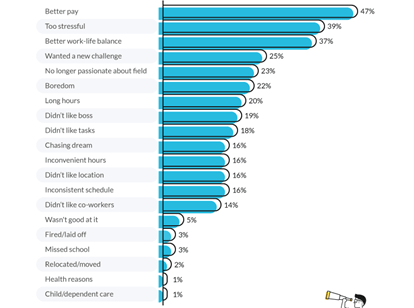
The top reasons for career change include pay, stress and work-life balance (Dec 13 2019, Joblist). Taking the time to decide what matters most to you may ensure your happiness in a future position more than any ‘success’.
However, if you’re feeling a bit like you’ve stalled and are not sure what to do next, I would advise against this sudden change. More minor changes may give you the sense of purpose you require and improve your happiness. You could take the time to take pleasure from the ‘smaller’ successes. These successes could be career-adjacent rather than direct results. For example, if you have recently improved your work-life balance, celebrate it. You could focus on learning whether an entire course or an Excel trick you never knew existed. If you’re improving, then you’re succeeding, and you deserve to be happy about that.
Taking smaller steps can be more sustainable, resulting in happiness rather than added pressure and leading to stress. If you can take a short course prior to an entire course to see how it fits with your life and what benefits it may bring, then this is the best option to improve your happiness and ignite your passion.
Which careers are you most likely to fall in love with?
You’ve decided you’re unhappy and want to change but are unsure what to do. You could take the next step with an existing interest and try a free online course somewhere like FutureLearn or maybe a class within your local community.
On the other hand, if you feel stuck in a toxic workplace with no potential for development but are still trying to figure out what to do next, why not take a career test? Popular tests include MyPlan or MAPP (Motivational Appraisal of Personal Potential). One of these may reveal skills and passions you did not fully realise you have.
If you take a career test and you don’t agree with the result or if you’re just the type of person to snort at these tests along with horoscopes and positive thinking (I’ll be honest, I didn’t take one), maybe the following statistics would be of more interest to you.
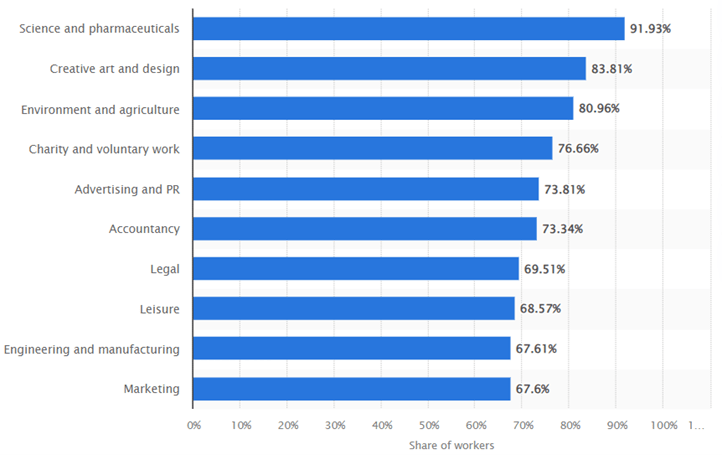
Statista has published statistics on the UK sectors where employees report the highest job satisfaction. ‘Science and Pharmaceuticals’ report the highest by a substantial margin at 91.93%, followed by Creative Art and Design’ and ‘Environment and Agriculture’ at 83.81% and 80.96% respectively.
Happiness = Productivity
Happier employees who love their jobs and feel invested in their workplace will have greater productivity outputs.
Even if you’re already satisfied with your job, there can always be room for further improvement. An open mind on both employee and employer sides should go a long way to achieve a productive, happy and successful environment for all.


 ThisandThat
Leave a comment